Home /Guides /How to Build a Campfire: Raising a Small Flame into the Star of the Evening
How to Build a Campfire: Raising a Small Flame into the Star of the Evening
A campfire is not something you light; it is something you raise. Hold a lighter against a thick log for as long as you like. It will not burn. But get the order right, and fire grows with surprising obedience, from a single match to the star of the evening. For anyone striking that match for the first time, here is the order of things.
Know Your Wood: Softwood Catches, Hardwood Lasts
If you find yourself hesitating in front of the firewood rack, there is only one thing to remember. Softwoods like cedar, cypress and pine are rich in resin and catch easily; they flare up fast and burn out just as fast. Hardwoods like oak are the opposite: reluctant to catch, but once lit they burn long and quietly. In other words, softwood plays the opening act as kindling, and hardwood carries the night.
And fire can only climb from small to large. What burns first is tinder: teased-apart hemp twine, dry leaves, pine cones, crumpled newspaper. From there it passes to twigs, to finger-thick sticks, to arm-thick logs. Building that staircase, step by step, is the most important work you will do before the first spark.
The Build: Log Cabin or Teepee
There is no single correct way to stack firewood, but two classic forms are worth knowing. The first is the log-cabin lay: sticks crossed into a small square tower, like the character for a well. Air enters from all four sides and the flame stands tall and straight: quick-burning, suited to a night when you want the drama of a blaze. The second is the teepee: tinder at the centre, twigs leaned into a cone around it, a tent in miniature. The flame gathers naturally toward the middle, so the fire raises itself. If this is your first time, start here.
One principle underlies both forms: fire feeds on oxygen. Leave gaps between the sticks for the wind to pass through. A tightly packed tower looks impressive, but to a fire it is a room with no air to breathe.
The Lighting: From Below, From Windward, Then Let It Be
Flame travels upward, so you light the lowest thing: the tinder. On a breezy day, light from the windward side and the wind will carry the fire into the wood for you. Feel the breeze on your cheek, note its direction, then kneel.
Once the tinder takes and the twigs begin to crackle, the next few minutes are for watching only. You will want to poke, to worry, to rearrange, and every touch lets the heat escape. Learning to build a fire is largely learning to keep your hands still. Add wood only after the flames have fully claimed what is already burning: one piece at a time, laid gently into a gap. When the fire is steady, switch to hardwood, and the night settles into its long, slow burn.
A Stay with the Firewood Taken Care Of: KEIKOKU GLAMPING TENT

For a first fire, it helps to practise somewhere the tools are already waiting. Along a mountain stream in Hinohara Village, Tokyo’s Okutama valley, stand just two fully private villas, each with its own firepit, and the firewood is free. You can face the flames for as long as you like, the clear stream murmuring beside you. Here even the bath runs on wood: sweat it out in a wood-fired private sauna, cool off in the outdoor jacuzzi with the river breeze, then give the evening to the fire. Check-in is unmanned, so nothing interrupts the hours you spend raising your flame. A school of fire, about 90 minutes by car from central Tokyo.
A Stay Where the Fire Waits After the Bath: AMAO VILLA Izu Kogen

This whole-house villa wrapped in the greenery of Izu Kogen sleeps up to twelve. Finish dinner on the terrace gas BBQ, and the firepit takes over. With a large group, fire-building becomes a natural division of labour: one person sorting branches, one stacking, one striking the match. Warm up first in the stone-built indoor hot spring bath, and the contrast between night air and lingering heat is its own pleasure. Dogs are welcome too. About 10 minutes on foot from Jogasaki-kaigan Station. Check the official site for whether firewood and fire starters are provided.
Most Failures Are Just Impatience
Fires that will not burn tend to fail for the same few reasons. The most common: trying to light a thick log directly. You cannot skip steps on the staircase. Next: overpacking the wood. The extra pieces added with good intentions block the air paths and smother the flame. If you are getting smoke but no fire, the wood is either damp or packed too tight.
And then there is over-handling. A fire that looks like it is dying is often just building its bed of embers; leave it unbroken and the flames will return. A campfire is not a dish that improves the more you stir it. The preparation is your work. The burning is the fire’s.
A Stay for Raising a Fire at the Foot of Fuji: ASH Villa Fuji Kawaguchiko
 Official siteVillaFuji Five Lakes · YamanashiASH Villa 富士河口湖Up to 10 guestsView this stay →
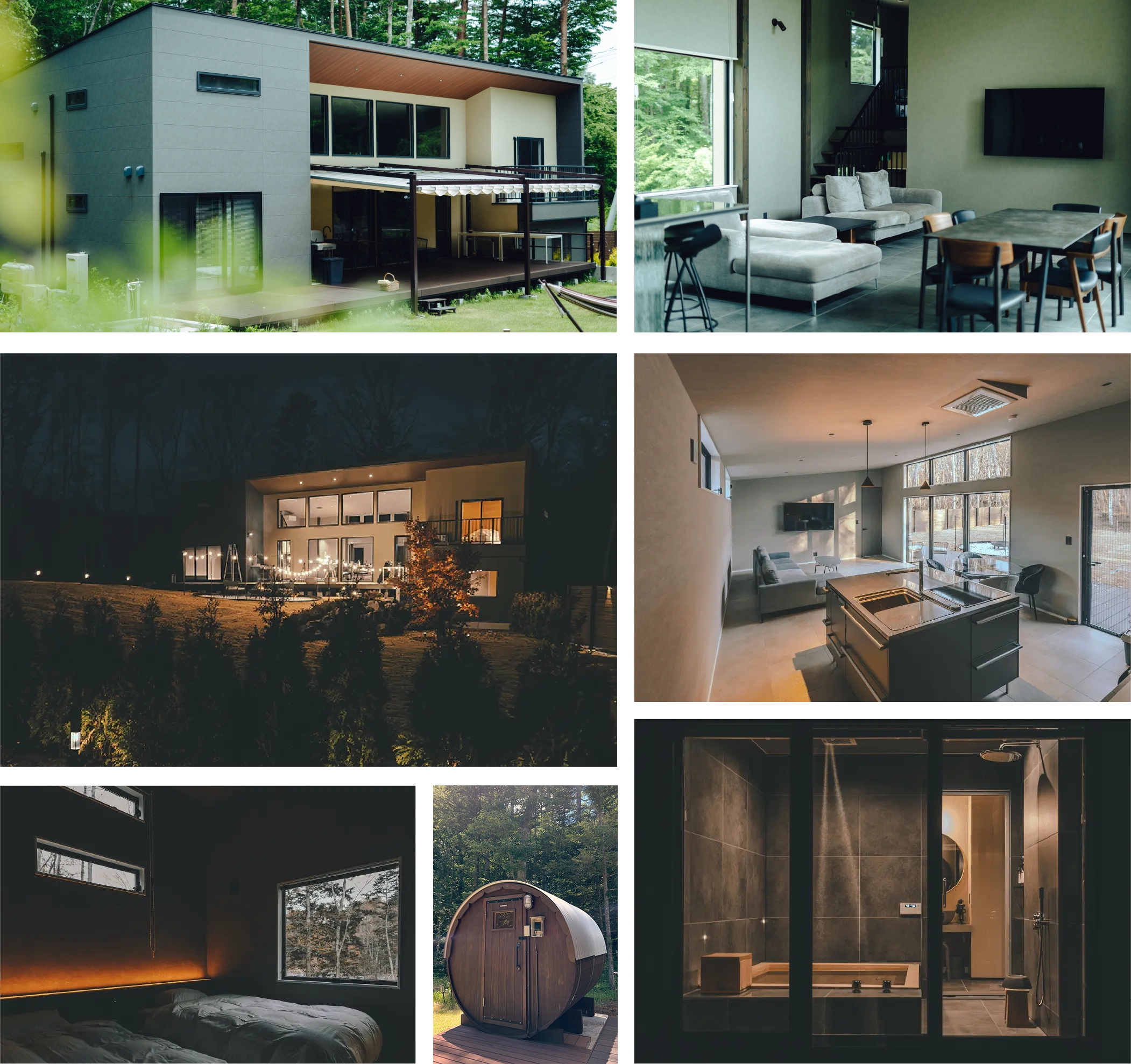
At these two private villas in Narusawa Village at the foot of Mt. Fuji, the garden fire is the axis the evening turns on. Warm yourself in the semi-open-air bath, cook dinner in the thoughtfully fitted kitchen, then step into the garden and build your fire. Even in summer the mountain air is cool and clear, and the warmth of the flames is exactly right. Dogs are welcome here as well. Check the official site regarding firewood.
A Fire Is Not Finished Until It Is Out
Finally, the most important part. A campfire is not something you may build anywhere. Always follow the property’s rules: use the designated hearth or firepit, a fire-resistant mat, whatever place and equipment the house prescribes. An open fire on grass or a wooden deck is out of the question.
Before bed, extinguish it completely. Either burn the wood down to ash, or pour water over it slowly and stay until the ashes are cold to the touch. “Probably out” means not out. Dispose of the ashes as the property instructs. And on a windy day, have the courage not to light a fire at all. Sparks fly farther than you imagine. For the nights you wisely give up, a good fire-friendly stay keeps other fires waiting: a hot spring, a sauna.
Respect the order, read the wind, keep your hands off. That is all a fire asks. What the night beside a well-raised fire feels like, we wrote in A Night Around the Fire (column). The next first match should be yours to strike.
Stays in this article
Izu & AtamiShizuoka
AMAO VILLA 伊豆高原
A whole-house villa on 300 tsubo of woodland in Izu Kogen, with a turf dog run and no limit on how many dogs come; they are welcome in the living room, the bedrooms and on the beds. Four bedrooms, sleeps twelve.
4 bd
Official siteFuji Five LakesYamanashi
ASH Villa 富士河口湖
Two whole-house villas at Narusawa on the flank of Mount Fuji, opened in winter 2023. There is a semi-open-air bath, a fire pit and a considered kitchen, and the barrel sauna belongs to the two-bedroom villa. Dogs are welcome.