Home /Guides /Summer Science Projects, Solved at the Villa: A Private Stay as Your Family's Field Station
Summer Science Projects, Solved at the Villa: A Private Stay as Your Family's Field Station
Of all the summer homework, the science project is the one that lingers until the last week of vacation. You want a family trip; the kids need a project, so combine them. At a whole-house rental, the entire grounds belong to your family from check-in to check-out. Look up at the stars from the garden at night, walk the nearby shore in the morning, gather around a fire at dusk. With a timetable entirely your own, the house becomes a small field station for curious children. All you need to pack is a notebook, a pencil, and a little curiosity.
Night Shift: Stars Become Science When You Record Them
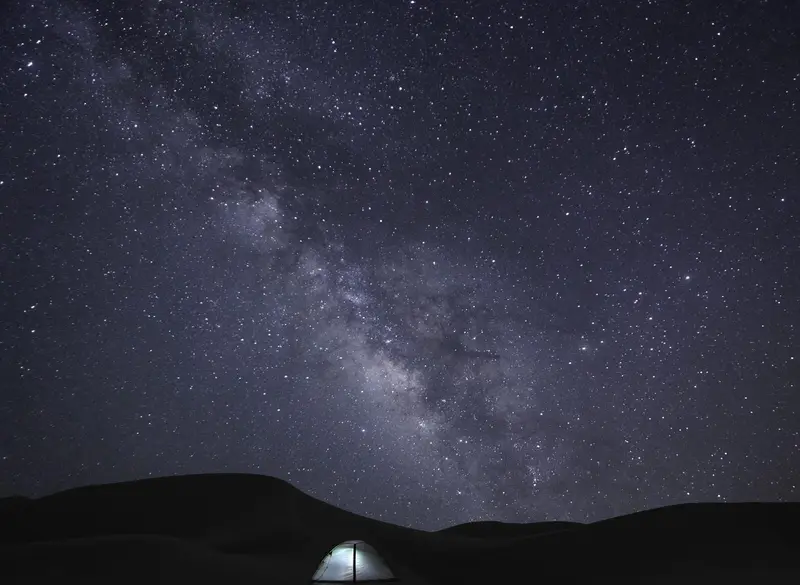
Stargazing alone isn’t research; recording is what makes it research. The method is simple. Stand in the same spot in the garden or on the terrace and sketch the positions of the stars every hour, using a tree or a rooftop as your fixed landmark. Stars rise in the east, set in the west, and the northern sky slowly wheels: a line from a textbook, confirmed by your own drawing. If the moon is out, note its phase and shape; the difference from tomorrow night becomes your analysis, ready-made.
In August, the nights around mid-month coincide with a meteor shower, when shooting stars multiply. Simply counting them and logging the times is genuine observation. For a full viewing guide, see our Perseid meteor shower column. One rule above all: nighttime observing stays within the grounds of your stay. A private garden is dark enough.
A Base for Stars and Forest: Forest House DAISEN

Inside Daisen-Oki National Park, at an elevation of 800 meters, this fully private cottage sits wrapped in the forests of Mt. Daisen and a sky full of stars: the location itself is the object of study. It sleeps up to 21, so even a three-generation trip with all the cousins fits under one roof. Sketch the stars at night, then switch to a forest walk in the morning: count cicada shells, log the birdsong by how many kinds you can tell apart. There is an induction kitchen for breakfast, and BBQ in the green season. Across TOMARIBI (泊まり火), the going rate for a villa is around ¥70,000 per night for the whole house. Split among a large group, your field station rents for roughly ¥10,000 a person.
Morning Shift: Tide Pools Open at Low Tide
On the coast, the real session begins when the tide goes out. The night before, look up the next day’s low and high tide times, and head to the shore as the water retreats. Tide pools hold small crabs, hermit crabs, and shellfish; the beach collects washed-up shells. Sorting your finds into bivalves (two halves joined at a hinge) and spiraling gastropods is a first genuine step in classification. Arrange them by shape, color, and size, and record where each was found.
Three promises here. Always walk the rocky shore with an adult. Check the tide times so the rising water never cuts off your way back. And return every living creature to the spot where you found it. Bring non-slip shoes, hats, and water, and never touch an unfamiliar animal with bare hands.
A Base You Can Walk to the Sea From: Cairns House by SANA Tateyama

On roughly 20,000 square meters of greenery in Tateyama, just two parties a day. The main house with its seven-meter ceiling and the art-filled ANNEX together sleep up to 16. The sea is about a five-minute walk: close enough to make low tide with your bed-hair intact. Spread the morning’s shells across the terrace for a family sorting session. The grounds also hold a tennis court and a trampoline, so children who need to move between observations won’t be bored. BBQ is free of charge, there is a free shuttle from Tateyama Station, and Tokyo is about 90 minutes away by car via the Aqua-Line.
A Base on the Inlet: GIFTHOUSE Miura Moroiso

At the southwestern tip of the Miura Peninsula, on an inlet whose very name, Moroiso, contains the word for rocky shore, stands a fully private villa taken by just one party a day. The sea fills every window, with views of Mt. Fuji and the sunset, so an evening study (logging the sunset time and the changing colors of the sky) practically writes itself. BBQ, campfires, and SUP are available as options, and the villa sleeps up to 6. At about 90 minutes by car from central Tokyo, even a single night leaves ample observing time.
Evening Shift: Fire Is a Study in Color and Combustion
If your stay allows fire, dusk is when science class resumes. Look closely: a flame is not one color. Near the base of the wood it turns bluish; the rising flame is orange: the difference in color is a difference in temperature. The wood matters too: softwoods like cedar and pine burn fast and fierce, while hardwoods like oak burn slow and long. Fan air gently toward the fire and the flame brightens, because burning needs oxygen. Track the whole arc, down to the white ash left at the end, and you have a complete experiment.
But fire demands stricter promises than stars or tide pools. Fire is handled only with an adult. Whether and where open fires are allowed differs at every property. Use only the designated place and equipment the facility approves, and follow its rules. Keep water for extinguishing within reach, and let an adult confirm the fire is fully out. Putting the fire to bed is part of the observation.
Write-Up: How to Keep a Field Notebook
What turns observation into research is the shape of the notebook. Each page needs only five things: date and time, place, weather and temperature, a sketch of what you saw, and “what I noticed / what puzzled me.” Fine drawing is unnecessary: arrows and a one-line note are plenty, and drawing by hand makes you look harder than a photo ever will.
And carry one question home. Why is the water in a tide pool warm? Why do shooting stars seem to come from the same direction? Look it up afterward in a field guide or at the library, add what you find, and the trip’s record is complete as research. The stay ends at check-out, but that is when the project enters its final stretch. Pack one notebook, and this summer, the homework and the family trip finish together.
Stays in this article
Mt. DaisenTottori
フォレストハウスだいせん(Forest House DAISEN)
A whole-house cottage for up to 21 guests at 800 m in Daisen-Oki National Park. It has three bedrooms and two tatami rooms, with three shower booths and one bathroom.
1 ba
Boso PeninsulaChiba
Cairns House by SANA(ケアンズハウス)館山
A two-groups-per-day rental on 20,000 sqm of green land in Tateyama. A main house with a 7 m atrium stands alongside the ANNEX, and BBQ equipment in the garden dining area is free to use.
3 bd
Miura PeninsulaKanagawa
GIFTHOUSE 三浦 諸磯
A one-group-per-day villa facing the inlet at Moroiso, on the southwest tip of the Miura peninsula. The sea in front is a SUP spot, there is a fire pit and a proper BBQ grill, and the hour when Mount Fuji and the setting sun align is the thing to catch.