Home /Guides /Three Generations Should Not Try to Keep the Same Hours: Choosing a Whole-House Stay by Steps and Bedrooms
Three Generations Should Not Try to Keep the Same Hours: Choosing a Whole-House Stay by Steps and Bedrooms
Dinner at a Japanese inn starts at six or half past six. Breakfast is at half past seven. Travel with three generations and those two times become the skeleton of the day. The grandparents have been awake since before five; the teenager will not surface until ten. The three-year-old gets sleepy at seven, which is precisely when the adults have opened the sake. Asking everyone to sit at the same table at the same hour is, on reflection, a fairly unreasonable promise.
Most of what makes a three-generation trip tiring is not the destination. It is the work of synchronising.

Rent the whole house and the promise disappears. There is a kitchen, so whoever wakes at five makes coffee, and whoever wakes at ten cooks then. Everyone stays under one roof on separate timetables. For three generations, a private house is less a luxury than a shelter.
The kitchen is a device for pulling hours apart
A set menu is welcome because you do not have to cook it. But a set menu comes with a clock attached. Of the 654 places listed on Tomaribi, 311 have a kitchen. For three generations, that is the dividing line.
Meals for the oldest generation are usually a question of content and timing rather than quantity: something in the stomach before medication, a smaller dinner, an early night. The youngest generation has its own constraints, from baby food to allergies. A kitchen lets both work at once. Removing the situation where somebody has to put up with it matters more than you would think.
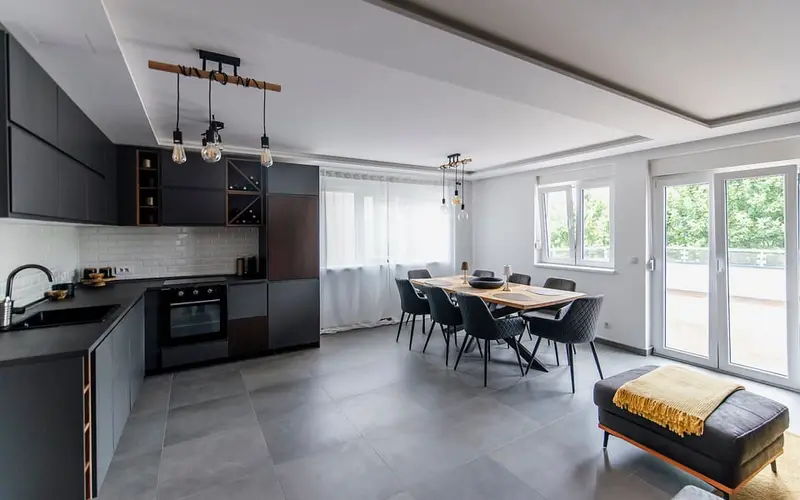
Nobody mentions the steps
The most overlooked thing in booking for three generations is the step. The reason is simple: the person affected never raises it. A sore knee still gets “I’m fine.” The raised entrance floor, the lip of the bathtub, the staircase to the second floor. Whoever plans the trip has to check in advance.
The reality is worth stating. Of the 654 listings, only 8 state barrier-free or wheelchair access on their official site. Adding those that state they are single-story brings it to 13. That does not mean the rest are full of steps; it usually means the information simply is not published, so asking is the fastest route. Still, a place that states it up front has, by that fact, some experience of hosting guests who need it.
Four bedrooms with no steps between them: Shinnei villa-monet Aso

A single-story villa inside Aso-Kuju National Park, taking one group per day. Four fully separate bedrooms, a dining table seating eight, a BBQ terrace, and space for up to eight guests. Rates run around 40,000 yen for two on weekdays and about 50,000 yen on Fridays, Saturdays and the eve of holidays. Single-story plus four bedrooms is close to the ideal shape for three generations. There is one bathroom, so agree on the bathing order in advance.
Leaving the stairs to a lift: Sora no Niwa Crescent Moon

A 250 sqm house standing in roughly 20,000 sqm of grassland on the Adatara plateau in Fukushima, rented whole. The building is barrier-free and has a lift. The ground floor is a living hall of about 100 sqm with a natural-wood table for eight and a kitchen. Upstairs are two suites with four beds each, both with a bath looking out over the plain (with shoulder-massage and cascade jets). Eight can sleep in the upstairs suites, and up to twelve when futons are laid out in the living room. Having futons as an escape route for the generation that dislikes beds quietly matters. The baths in the house are not hot-spring water, but guests may use the free-flowing Dake Onsen baths at the sister property for free. Rates start around 150,000 yen per night.
Reaching the bath without a communal changing room: Amanohashidate Miyazu Harbor

For the unaccustomed, a communal bath is also “a place where you undress in front of strangers.” When grandparents decline a soak, that, rather than stamina, is often the reason. These two villas on Miyazu Bay in Kyoto are barrier-free and single-story, with a mineral-stone artificial onsen bath called kuguri-yu (not natural hot-spring water). The bathroom windows open wide to the sea, and each villa has an infinity pool that seems to merge with the bay. There is an island kitchen, and you can choose either a self-catering plan or a BBQ plan with a kids’ menu. About 10 minutes by taxi from JR Miyazu Station, with a taxi-fare subsidy.
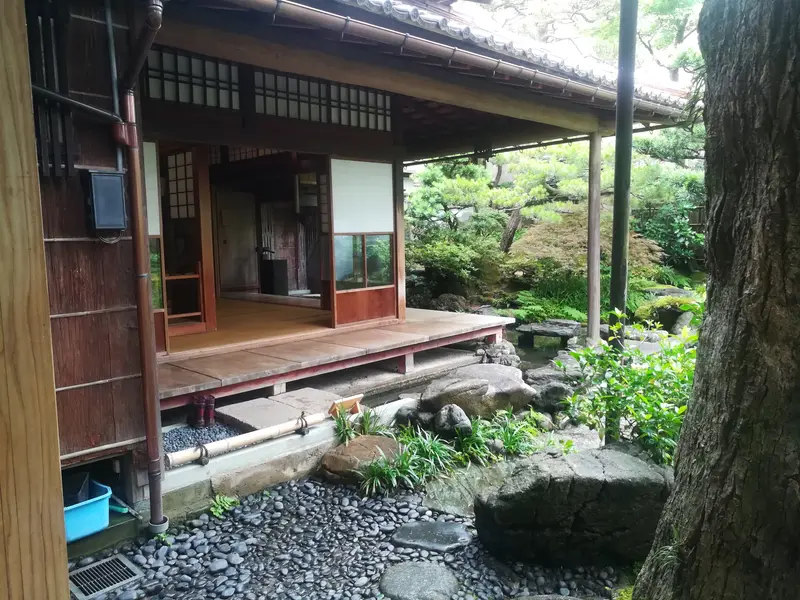
The engawa is a well-designed instrument: Hirado Yokota

A whole-house rental on the coast of Hirado in Nagasaki, taking one group per day. A single-story house built in the traditional local manner with an engawa veranda, and every room looks out to sea. There is an indoor bath and a semi-open-air bath, and BBQ in the attached garage. It sleeps 15; with five guests the guide price is from about 5,900 yen per person.
The engawa feels like a structure invented for multi-generation travel. A grandparent sits and watches the sea, a child runs past barefoot, and the parents keep both in view while doing nothing at all. Very few modern houses still contain a single place where three speeds can coexist.
Count the bedrooms by counting the snorers
Bedroom counts often go unpublished. Of the 654 listings, 134 publish theirs: 67 have three or more, and 24 have four or more. Only 13 state that they have two or more bathrooms.
For three generations, you want as many bedrooms as generations. Bedtimes split three ways, and there is the snoring problem. Get this wrong and somebody is in a bad mood the next day. Note that a large capacity and a large number of bedrooms are different things: 237 listings sleep eight or more, but only some of those publish a bedroom count. Whether the party fits and whether each generation can have its own room are two separate things to check. Some, like Glamp Terrace on Okamura Island in Ehime, place two large domes on a single site so that sleeping quarters can be divided.
If the priority is a short journey, proximity to a station is its own criterion. Shimao Dream Beach in Himi, Toyama is about a five-minute walk from JR Shimao Station and twenty paces from the sand; cottage D is barrier-free, with plans for wheelchair users and for dogs. Five futons in the loft bring it to seven guests.
Respect for the Aged Day 2026 falls on 21 September
In 2026, Respect for the Aged Day is Monday 21 September, and 19 (Sat) to 23 (Wed) forms a five-day break. The details are in our Silver Week article, but years in which three generations have five clear days lined up are not that common. Over long weekends the places that take few groups fill first, so it pays to move early.
What tends to stay with people after a three-generation trip is not the hours everyone spent doing the same thing. It is a grandfather drinking tea on the veranda at five in the morning, a grandchild still asleep, and both of them awake in the same house. Choosing a stay that does not force everyone onto one clock is, in the end, for that.
Stays in this article
Mt. AsoKumamoto
森寧 villa-monet(ヴィラ・モネ)阿蘇
A single-storey private villa standing alone inside Aso-Kuju National Park. It has four fully separate bedrooms and a dining table seating eight adults, surrounded by forest and the sound of a stream.
4 bd1 ba
HiradoNagasaki
一棟貸し 平戸よこた
A traditional Japanese house at Tabira in Hirado, let to one group a day. A single-storey building with an engawa and sea views throughout, plus a BBQ garage, a half-open-air bath and a private cinema.