Home /Guides /When the Bath Is Outside the House: Whole-House Stays in an Onsen Town
When the Bath Is Outside the House: Whole-House Stays in an Onsen Town
The value of a private stay is usually explained as not meeting anybody. From check-in to check-out you see no other guests, and the bath and the meals run at your own pace. We have written it that way throughout this series.
Whole-house stays in onsen towns do the opposite, because the bath is outside the house.
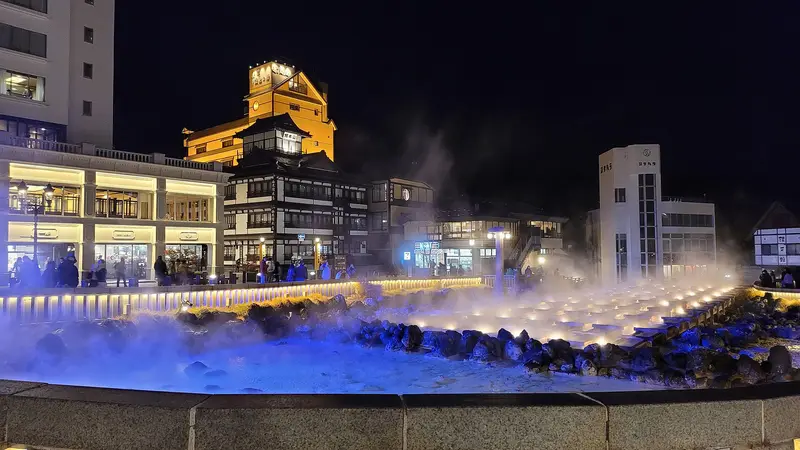
A whole house with no bathtub: Kinosaki Onsen Yukkura

In Kinosaki, Toyooka, Hyogo, a sake merchant’s storehouse converted into a whole-house rental (opened 2023). One group only, up to six adults, with one bedroom holding two semi-double beds and four futons. It has a full kitchen, free Wi-Fi, BBQ (hired) and two free parking spaces, about five minutes on foot from JR Kinosaki Onsen Station. From around 46,000 yen a night.
The house has no bathtub. There is a single shower room, and bathing happens at the public baths, the nearest about ten minutes away. By the arithmetic of our piece on bathroom counts this is the worst possible arrangement, and in Kinosaki it is the right one. The town is built around walking between seven public baths in yukata and geta, and a bath in the house would only reduce your reasons to go out.
Turn the storehouse into lodging, and leave the bath to the town. Filter on facilities alone and you drop the most Kinosaki-like option on the list.
A villa in the back streets with no hot spring: Yubatake Villa Ura-Kusatsu
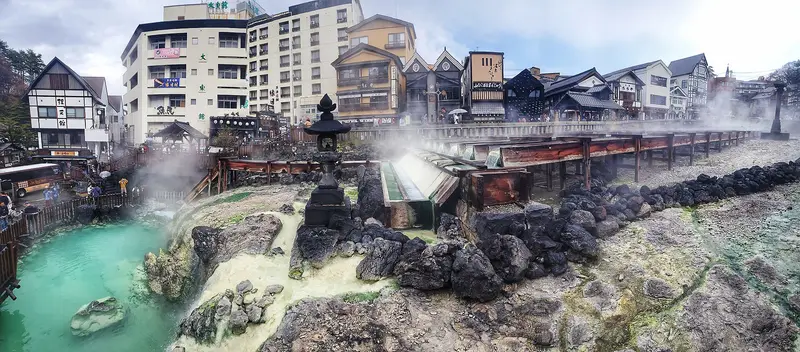
In Kusatsu, Gunma, a whole-house rental in the back streets near the Yubatake. It is a modern Japanese three-bedroom house sleeping ten, with quality mattresses, a full kitchen, free Wi-Fi and parking for two, renovated in September 2023. There is no hot spring, sauna or BBQ equipment indoors; the hot springs are the ones nearby. Dogs are not accepted, and it is within walking distance of the bus terminal.
Kusatsu is a town organised around the Yubatake, with public baths and foot baths scattered through it, so having the bath outside the accommodation is simply normal. Ten people take a house, each goes to a bath when they feel like it, and everyone reconvenes in the kitchen. Seen another way, this is a large-group stay with no queue for the bathroom, which is rather rational.
In the same town, Eidaya Showakan is a four-bedroom rental for six with free-flowing “Wata-no-yu” hot spring water in the house, its main inn about seven minutes away by car. A stay that sends you out, and a stay that keeps you in. It is interesting that one hot spring town holds both.
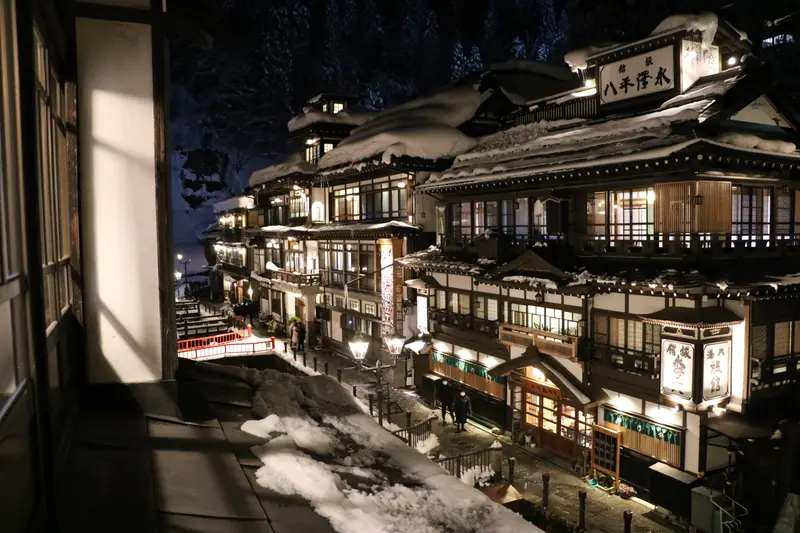
Silver water, thirty minutes from Sannomiya: Arima Onsen Kotori

In Arima, Kita ward, Kobe, a small inn in Arima Onsen that offers a whole-house plan. Guests bathe in the celebrated “ginsen” silver water, and there is free parking and a lounge. It is about 30 minutes by train from Sannomiya in Kobe and about nine minutes on foot from Arima Onsen Station, with a pickup on arrival.
Arima’s strength is that proximity to the city converts directly into time on the ground. Thirty minutes from Sannomiya means arriving in the afternoon, walking the town, bathing, and bathing once more the next morning before leaving. The shorter the travel, the longer you are actually in the town.
Sleeping on a ryokan roof: Zao Onsen Matsukaneya Annex
 Official siteGlamping山形県 · 蔵王温泉街蔵王温泉 松金屋アネックスFrom JPY 22,000 / nightView this stay →
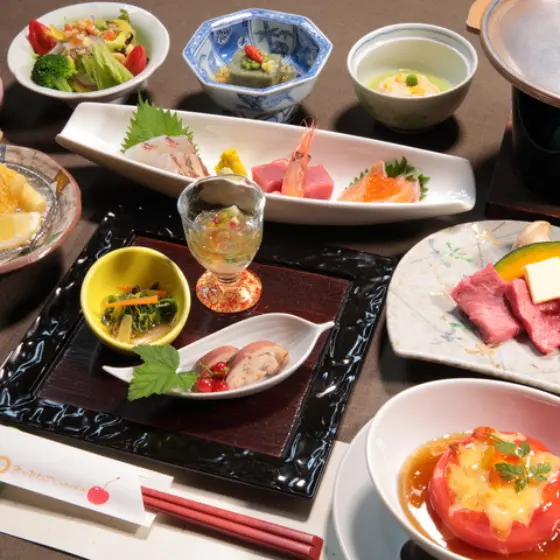
In Zao Onsen, Yamagata, a free-flowing hot spring ryokan in the town with glamping on its roof. Two dome types sit where the Zao range is visible in every direction: “SUNRISE” facing the morning sun and “SUNSET” facing the evening, each paired with a Japanese-style room with its own bath and toilet, which suits older guests and small children.
Bathing is either the cypress-built free-flowing view bath (strongly acidic sulphur spring) or, for those who find sulphur difficult, the weakly alkaline artificial spring in the public bath and open-air bath. Meals are local and creative cooking with Yamagata beef, sanngen pork and seafood. From around 22,000 yen a night, about 40 minutes by bus from JR Yamagata Station.
A ryokan roof is a variation on the onsen-town whole-house stay: you are inside the town, but the part where you sleep floats slightly above it.
The practicalities of staying in an onsen town
The comfort of a whole-house rental and the customs of an onsen town do not quite align.
- Check the bathhouse hours first. Public baths close, unlike the bath in your room. A late check-in can mean no bath on the first night.
- Yukata and geta depend on the property. A ryokan provides them; a whole-house rental is a house, so often it does not. Rent in town, or bring shoes you can walk in.
- Count your towels. Several trips to the baths will outrun what the property provides. Check where you can dry them, too.
- Plan meals around going out. Whole-house rentals usually have kitchens, but onsen towns close early. Decide in advance whether you are shopping or reserving.
- Quiet runs both ways. The lanes are startlingly silent late at night, and geta carry. Coming and going after dark calls for the same courtesy you would use at home.
If you are choosing a private stay as a place to shut yourself away, the onsen-town whole-house rental looks weak on paper: no bath, no sauna, no pool. Then you open the door and there is a town. Buying the location instead of the facilities is a way of choosing that works.
FAQ
- Do whole-house stays in onsen towns have a hot spring?
- Not all of them. Yukkura in Kinosaki has no bath in the house, only a shower room, on the assumption that guests use the public baths. Yubatake Villa in Kusatsu has no hot spring or sauna indoors either. By contrast, Eidaya Showakan in Kusatsu does have free-flowing hot spring water in the house.
- What is sotoyu-meguri?
- It is the custom of walking between the public bathhouses scattered through an onsen town in yukata and geta. Kinosaki is the best-known example, where the accommodation serves as a changing room and a base. Distances from the property to the nearest bathhouse are given on official sites.
- Can you walk to these stays from the station?
- Some of them. Yukkura in Kinosaki is about five minutes on foot from JR Kinosaki Onsen Station, Kotori in Arima about nine minutes from Arima Onsen Station (with a pickup on arrival), and Yubatake Villa in Kusatsu is within walking distance of the bus terminal.
Stays in this article
Kinosaki OnsenHyogo
城崎温泉一棟貸しの宿 ゆっ蔵(ゆっくら)
A whole-house rental at Kinosaki Onsen, converted from a sake merchant's storehouse dating to the Meiji era. There is no bath in the house; the seven public baths around town are the point. Five minutes on foot from Kinosaki-Onsen Station.
1 bd1 ba
Kusatsu OnsenGunma
湯畑ヴィラ 〜裏草津〜
A Japanese-modern whole-house rental on a back lane at Kusatsu Onsen. Three bedrooms sleep ten. There is no hot spring or sauna inside; the house is meant as a base for walking to the Yubatake and the public baths.
3 bd
Arima OnsenHyogo
有馬温泉の宿 小都里(ことり)
A small eight-room inn at Arima Onsen. Rooms follow the theme of seasonal flowers, a whole-building plan is available, and the celebrated silver spring is here. Arima-Onsen Station is nine minutes on foot, with a shuttle available.