Home /Guides /Kitchens at Villas, Bathhouses at Glamping: Why Facilities Divide
Kitchens at Villas, Bathhouses at Glamping: Why Facilities Divide
A kitchen appears at 68% of villas and 27% of glamping sites.
A hot spring is piped in at 4% of villas and 27% of glamping sites.
The same conversation about facilities, running in opposite directions. Tomaribi lists 654 stays: 321 private villas and 333 glamping sites, numerically an even split. The facilities inside them are not evenly split at all. And the way they land has a reason behind it.
The widest gap was the kitchen
Counting the facility records by type of stay, the kitchen showed the widest gap of all. 221 of 321 villas (68.8%), against 90 of 333 glamping sites (27.0%). A 2.5-fold difference.
Pools run the same way, 43.0% against 22.5%, as do jacuzzis and in-room hot-spring baths.
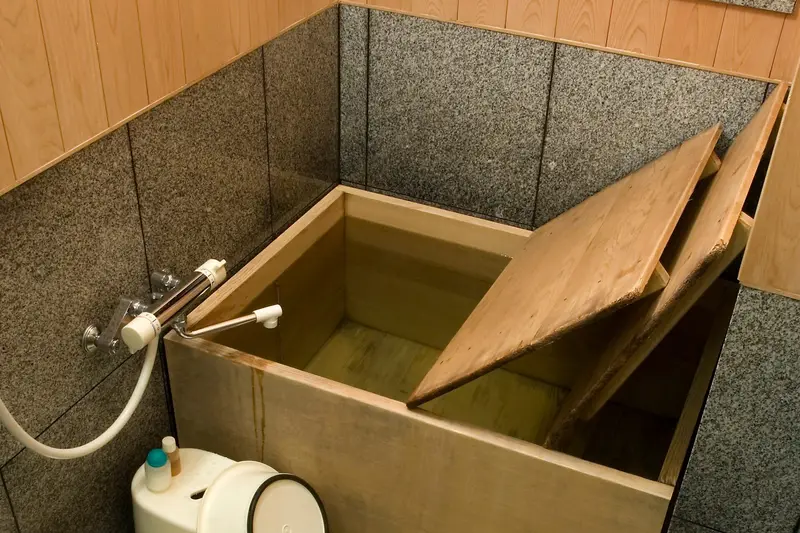
The reason is plain enough once stated: a villa is a house. A house has a kitchen, a bath, and the things you need inside the walls. Renting one whole is nothing more than renting that house.
The gap runs the other way for hot water
Some facilities lean hard the other way, and they are all about water.
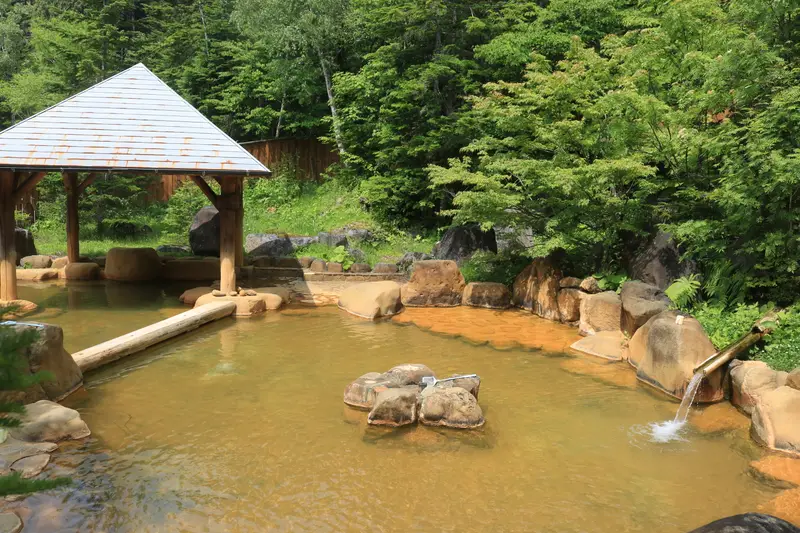
Hot springs are piped in at 13 villas (4.0%) against 91 glamping sites (27.3%), roughly seven times. Shared hot-spring baths sit at 5 villas (1.6%) against 36 glamping sites (10.8%), seven times. Open-air baths lean the same way, 26.3% against 18.0%. The body text sharpens it further: a large communal bath is mentioned at 40 glamping sites, against just three villas.
Why? Because a glamping unit is small. A bathhouse does not fit inside a dome tent or a trailer. So the bath is pushed outside the unit and gathered at the centre of the site or in a main building. GRAN FOREST Echizen Miyama in Fukui has a bathhouse fed by hot spring drawn from around 1,000 metres down, free to glamping guests. THE VILLAGE in Oita keeps towels and a hairdryer at the clubhouse bath, so you walk over empty-handed.
Gathering raises the quality. One large bath is easier to fill, and easier to give a view, than twelve small ones. That hot springs cluster at glamping sites follows from the structure as much as from taste.
In exchange, you walk outside at night
Gathering has a flip side: you leave the unit to reach the bath.
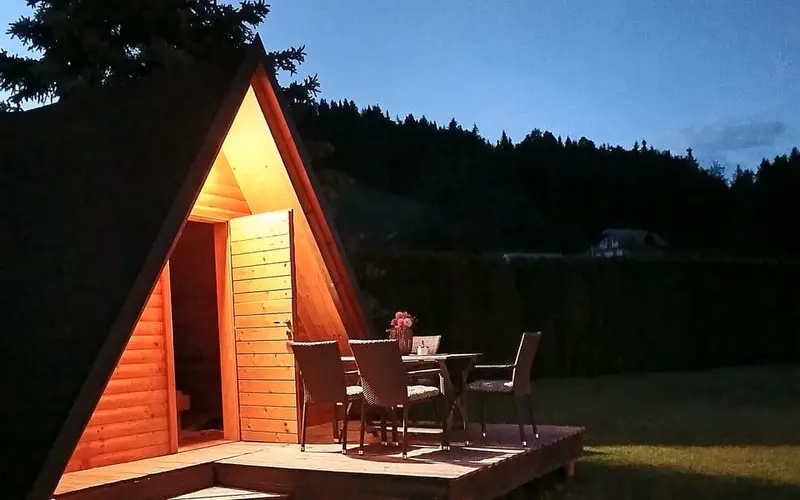
At 99glam in Akita you sleep in a dome and the toilet and bath are inside the neighbouring inn, Ichie. Manten Iori in Gifu has neither bathroom nor toilet in the unit, so bathing happens free of charge at the adjacent hot spring, Manten no Yu. Also in Gifu, HOKO ENA puts showers in the management building and bathing at the Ena Sanso bathhouse. At Hiruzen Kogen Glamping in Okayama, the bathroom and toilet are shared space in the management building. LUMP COURT Isumi in Chiba puts the shower room and toilet in a separate building; Hoshifull Dome Fuji in Yamanashi places a guests-only shower block and toilet right beside the tents.
None of this is a flaw; it is a design. But whether you will be walking outside on a winter night, or with a child in tow, is the kind of thing worth knowing in advance. Whether the toilet is inside the unit matters most on a wet day.
Why nearly every glamping site has a BBQ
The most widespread facility at glamping sites is the BBQ: 320 of 333, or 96.1%. Villas are high too at 246 (76.6%), but glamping is nearly universal.
This is the kitchen finding turned inside out. If you cannot cook inside the unit, you cook outside it. At a glamping site the BBQ is less an option than a premise. At a villa, kitchen and BBQ often both exist, and you pick according to the evening.
Cooking points to villas, grilling to glamping. Crude, but the odds bear it out.
Washing machines, as evidence from the other side
One more facility tests the hypothesis backwards: the washing machine.
There is no facility tag for it, so counting the body text: washing machines or dryers appear at 31 villas against seven glamping sites. The same direction as the kitchen, and just as clear. Exactly what “the functions of daily life live inside the building” predicts.
What makes it interesting is what those seven are. OAK VILLAGE in Nagano puts an induction kitchen, a bathroom and a washing machine inside trailer homes. Kawazu Beach House BLUE MOON in Shizuoka has three free-standing units, each with a flush toilet, a shower room and space for a washing machine. Beach Spa Tsuda in Kagawa has a fully equipped kitchen and a washing machine, built for longer stays.
Call it glamping if you like: once the unit takes the shape of a building, the functions of daily life move inside it. What decides the facilities is not the label on the stay but the shape of the structure.
The villa-side exceptions fit the same logic. Of the three villas mentioning a large bath, Glamday Umi Mori to Kaze Atami in Shizuoka has a free-flowing hinoki bath, a sauna and a cold plunge gathered into one “bathhouse” inside a single building; Blue Lagoon Toi in Izu adds two large baths to the baths in each room; Aconcagua Resorts in Kumamoto has a private bath and a rock-built bathhouse. All are large single buildings or multi-building resorts, at the scale where gathering starts to make sense.
Only the sauna came out level
After all that divergence, one facility barely diverged at all.
Saunas: 197 villas (61.4%) against 198 glamping sites (59.5%). Almost identical in both count and share. Parking (50.8% against 51.4%) and Wi-Fi (46.7% against 41.4%) are close too, but those are baseline infrastructure with no relation to the shape of the stay. The sauna is different.
Why level? Because a sauna is not a function of daily life. Kitchens, washing machines and baths come attached to the act of staying somewhere, so they are bound by the shape of the building. A sauna is not. It is something you can stay perfectly well without, that operators chose to add.
So it entered the house-like villa and the site-like glamping at the same rate. Put another way, the sauna sits outside the line that separates the two. How fast saunas moved into Japanese stays over the past decade also shows up in what makes newer stays different.
What this means when choosing
It comes down to one line: do the functions of daily life sit inside the building, or gathered outside it?
Inside, at a villa, you cook in the kitchen, do laundry, and walk a few steps to the bath. In exchange the bath is an ordinary one, and the odds of a hot spring are low. Gathered outside, at a glamping site, the odds of a large bath or a hot spring go up. In exchange you may leave the unit to reach the bath and the toilet, and cooking mostly means grilling.
So the question when choosing is not “villa or glamping, which do I prefer?” It is how many nights, will we cook, and can we walk outside at night. Those three usually settle it. For the terminology itself, see the difference between villas, glamping, cottages and rental houses.
What this counts, and what it does not
The denominator is 654 listings (published, duplicates excluded): 321 villas and 333 glamping sites. The facility percentages count facility tags recorded from official information, and facilities not stated are not counted. So the correct reading is not “73% of glamping sites have no kitchen” but “27% were confirmed to have one”.
The 40-against-3 for large baths and 31-against-7 for washing machines are counts of body text, not tags. How fully each listing is written varies, so these are coarser than the tag counts. Read them as direction rather than measurement.
Facilities also get added. Some properties drill for hot springs; others put in a sauna. Check the official site before booking.
FAQ
- How do facilities differ between private villas and glamping in Japan?
- The difference is where the functions of daily life sit. Kitchens appear at 221 of 321 villas (68%) against 90 of 333 glamping sites (27%). Hot springs run the other way: 13 villas (4%) against 91 glamping sites (27%), and shared hot-spring baths at 5 villas against 36 glamping sites.
- Can a glamping unit have no bathroom of its own?
- Yes, and several assume you will step outside. At 99glam in Akita the toilet and bath are inside the neighbouring inn; at Manten Iori in Gifu bathing happens at the hot spring next door; at Hiruzen Kogen Glamping in Okayama the bathroom and toilet are shared facilities in the management building. Worth checking before a winter trip or a trip with children.
- If I want to cook, should I choose a villa or glamping?
- A villa is the safer bet. Kitchens appear at 68% of villas against 27% of glamping sites, a 2.5-fold gap. BBQ equipment runs the other way: 96% of glamping sites against 77% of villas. Cooking points to villas, grilling to glamping.
- Which has more saunas?
- They are level. 197 of 321 villas (61.4%) and 198 of 333 glamping sites (59.5%), the smallest gap of any facility we counted. A sauna is not a function of daily life like cooking or laundry; it is something an operator chooses to add, so it spread to both equally.
- Do glamping sites have washing machines?
- Rarely. Washing machines or dryers are mentioned at 31 villas against seven glamping sites. Most of those seven are trailer homes or free-standing units, buildings rather than tents. For a long stay with laundry, the shape of the structure is the quicker guide.
Stays in this article

Izu & AtamiShizuoka
GLAMDAY VILLA 海森風(うみもりかぜ)熱海
A whole-house onsen retreat on the heights of Atami for up to eleven guests. Alongside a bath house with a free-flowing hinoki tub and sauna, each room has its own open-air or indoor spring bath, and the 86 sqm terrace looks out on the Atami fireworks.
4 bd

NishiizuShizuoka
サンセットオーシャンビュー ブルーラグーン
A villa resort in Nishiizu. With ocean views, an open-air bath, BBQ, a kitchen.

Mt. AsoKumamoto
ACONCAGUA RESORTS
A villa resort in Mt. Aso. With an in-room onsen, an open-air bath, onsen bathing.

KaruizawaNagano
COCO VILLA 軽井沢
A three-bedroom whole-house villa in the forest at Karuizawa. The grounds hold COCO VILLA's own 3D-printed sauna, with a cold bath and cooling area in its dedicated space.
3 bd1 ba

OtaruHokkaido
FARM VILLA taku
A whole-rental villa for one group a day inside the Takeshita farm at Nakashibetsu, where pasture stretches beyond the wood stove's flame. Two twin bedrooms, sleeping eight.
2 bd