Home /Guides /Two Bedrooms, Eight People: Working Out Who Sleeps Where
Two Bedrooms, Eight People: Working Out Who Sleeps Where
Sleeps eight. Two bedrooms.
Between those two numbers sits a conversation: who shares a room with whom.
And that conversation almost always starts after the booking is made. A few days before departure, someone in the group chat asks how you are splitting the rooms. By then the number of rooms is already fixed.
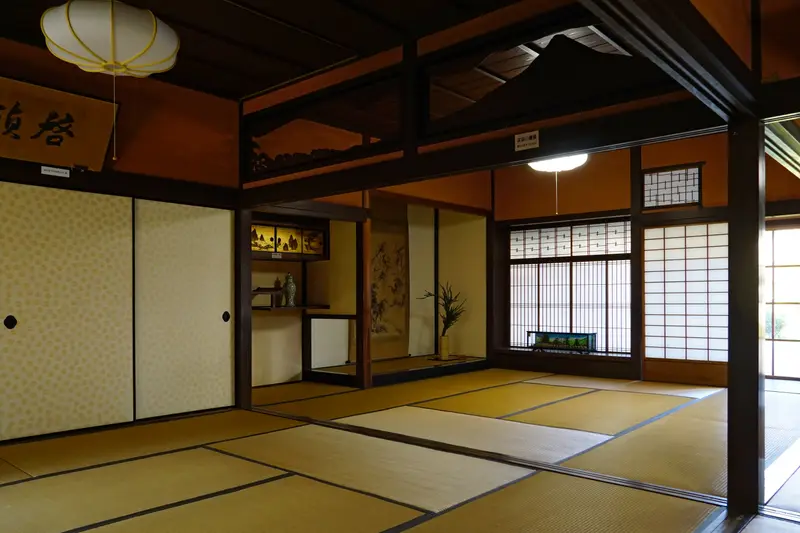
Capacity doubles, bedrooms do not
Group the villas by capacity and it becomes plain.
| Capacity | Villas | Median bedrooms |
|---|---|---|
| 4 or fewer | 10 | 2 |
| 5 to 6 | 28 | 2 |
| 7 to 8 | 28 | 2 |
| 9 to 11 | 23 | 3 |
| 12 or more | 20 | 3 |
Capacity doubles from four to eight and the median bedroom count does not move off two. It only begins to climb past nine.
The extra people are absorbed not by adding rooms but by adding beds to existing rooms, or futons to the living room. Capacity guarantees a place to sleep. It does not guarantee a room.
Exactly three per bedroom
Now the division. Of Tomaribi’s 321 villas, 134 publish a bedroom count, or 41%; 132 publish capacity as well. From those, 23 that describe more than one building were removed, because a property-wide capacity paired with a single building’s bedroom count gives a meaningless quotient.
Across the remaining 109, capacity divided by bedrooms gives a median of exactly 3.0 people per bedroom.
Three. Too many for one double bed, too many for two singles. Most of these places are furnished on the assumption that three or four people share a room.
In 43 of the 109, or 39%, the arithmetic puts four or more people in a single bedroom. Narrow to the 69 villas sleeping eight or more, and 23 (33%) have two bedrooms or fewer.
The crowded ones say so plainly
Look at that end of the range and it is clearly a design choice, not an oversight.
AMERI on Momoshima, Hiroshima has two bedrooms, one bathroom and a capacity of 18. Nine per room on paper, but that is not eighteen people crammed into two rooms; it is a house where eighteen can stay, living room and everything else included.
L’art de vie in Matsuyama, Ehime has an open plan with a single bedroom, two bunk beds and a loft, sleeping up to nine. Not dividing with walls was the starting point.
Yukura in Kinosaki Onsen, Hyogo is a converted sake merchant’s storehouse: one bedroom with two semi-double beds and four futons, six adults maximum. A kura is not a building you chop into small rooms.
UMInoTERRACE VILLA Chikura in Chiba sleeps 12 in two bedrooms but recommends six. As how many a child counts as showed, the recommended figure often describes the rooms better than the maximum does.
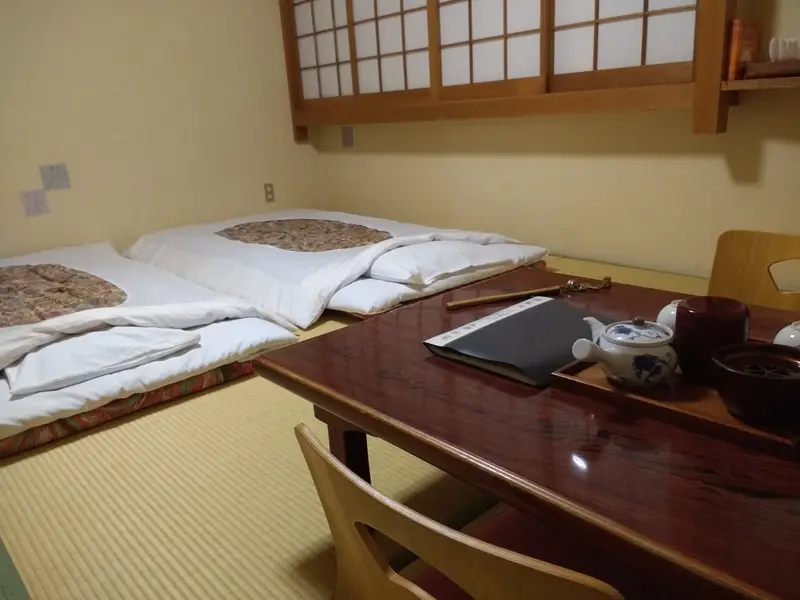
Some villas sell the room count itself
At the other end, 19 of the 109, or 17%, run at two people per bedroom or fewer.
The roomiest is Eidaya Showakan in Kusatsu, Gunma: four tatami rooms for a capacity of six, one downstairs and three upstairs in a 4LDK plan. That is 1.5 people per room.
villa-monet in Aso, Kumamoto and Kito NASU in Tochigi both have four bedrooms for eight, as does Private Pool & Sauna Villa TANIIKE SO in Hyogo. Four pairs fit, which means four couples or four households both work.
Snoring is not on any booking site
The same “two bedrooms” means completely different things depending on the party.
Two couples: two rooms is exactly right, and nothing more is needed. Six friends: the number of beds may matter more than the number of rooms, and if the point is talking late into the night, partitions are an obstacle.
Two households: one room per family. Whether one family can go to bed early with the children largely decides how the trip feels. Three generations: bedtimes and waking times diverge by generation. That problem is the subject of three generations should not try to keep the same hours, and separate rooms are what makes separate hours possible.
Then there is snoring, the variable no booking site records. Two bedrooms, eight guests, two snorers, and the room allocation suddenly becomes difficult.
Read bedrooms and bathrooms together
Twenty-eight of the 109 publish both counts, and putting them side by side shows you the morning.
MOROISOSO Miura in Kanagawa sleeps 18 across four bedrooms with one bathroom: four bedrooms upstairs, one bathroom and the kitchen downstairs. The rooms divide; the morning queue does not.
Villa Saison Fuji in Yamanashi counts its main house and annexe together for 24 guests, six bedrooms and three bathrooms. A large party, but both are distributed. It sits outside the tally above, being more than one building, yet it makes the point: villas with many rooms usually have more than one bathroom too.
As capacity grows, the bath does not set out, bathrooms scale even more slowly than bedrooms. Four bedrooms and one bathroom is an ordinary combination. When you plan the sleeping, picture the morning too.
What this counts, and what it does not
The denominator is 321 villas. Of those, 134 (41%) publish a bedroom count, so six in ten do not. That says nothing about how few rooms they have; plenty of places simply do not publish a floor plan. Glamping listings record no bedroom counts at all because of how that data is gathered, so this article is about villas only.
The 23 with multiple-building descriptions were excluded because a site-wide capacity beside a single building’s bedroom count will not divide. The exclusion keyed on counts of two buildings or more and on the words for an annexe, a wing, a main house and a detached cottage; the common phrase for renting a whole single house was not excluded. Running the calculation on all 132 gives a median of 3.33, so the exclusion lowers it slightly.
Knowing the number of bedrooms does not tell you how many beds are in each one, and most villas do not publish that. There, you have to ask.
Two things to do before booking
First, find out how many rooms it divides into. If the room count is not printed next to the capacity, ask. “How many bedrooms are there, and what bedding is in each?” usually comes back in a single exchange.
Second, share that allocation with the group before you book. If everyone knows it is eight people in two bedrooms, they can accept it in advance. Learning it on arrival leaves no choice but to sort it out on the spot.
The number of rooms is fixed the moment you choose the villa. The allocation can be settled long before that.
FAQ
- How many bedrooms does a private villa have relative to its capacity?
- Across the 109 villas on Tomaribi that publish both figures and describe a single building, the median is exactly 3.0 people per bedroom. Whether the capacity is four, six or eight, the median bedroom count is two. It only starts rising above nine.
- If a villa sleeps eight, can we split into two rooms of four?
- It depends. Of the 69 villas sleeping eight or more that publish a bedroom count, 23 (33%) have two bedrooms or fewer. In 43 of the 109 (39%), the arithmetic puts four or more people in one room. Beds for everyone does not mean rooms for everyone.
- How many bedrooms do two or three households need?
- One per household, if each wants its own room. Only 19 of the 109 (17%) run at two people per bedroom or fewer. Eidaya Showakan in Kusatsu has four tatami rooms for six guests; villa-monet in Aso and Kito NASU in Nasu both have four bedrooms for eight.
- Are there villas with only one bedroom?
- Yes. L'art de vie in Matsuyama has an open plan with a single bedroom, two bunk beds and a loft, sleeping up to nine. Yukura in Kinosaki Onsen has one bedroom with two semi-double beds and four futons for six adults. Fine with people you know well, less so with people who keep different hours.
- Where do I find the bedroom count?
- The floor plan on the official site. Only 134 of Tomaribi's 321 villas (41%) publish one, so six in ten do not. When it is missing you have to ask. Ask not just how many the villa sleeps but how many rooms it divides into.
Stays in this article

Kusatsu OnsenGunma
草津温泉付き貸別荘 永田屋 昭和館
A four-bedroom rental house at Kusatsu Onsen with the Watanoyu source piped into the room, a spring drawn by only a handful of inns. One tatami room downstairs and three upstairs.
4 bd1 ba

Mt. AsoKumamoto
森寧 villa-monet(ヴィラ・モネ)阿蘇
A single-storey private villa standing alone inside Aso-Kuju National Park. It has four fully separate bedrooms and a dining table seating eight adults, surrounded by forest and the sound of a stream.
4 bd1 ba

Nasu HighlandsTochigi
Kito NASU(キト ナス)
A four-bedroom whole-house villa in Nasu finished in solid wood. Its wood-fired Kino Sauna collects rainwater running off the roof into a hollow that serves as the cold plunge. Sleeps eight.
4 bd

Boso PeninsulaChiba
UMInoTERRACE VILLA(海のテラス ヴィラ)千倉
A whole-house villa inside Minami-Boso Quasi-National Park. It has an infinity pool facing the sea, a barrel sauna and a BBQ table with built-in burners, and a dome tent sleeping space alongside two indoor bedrooms.
2 bd

Kinosaki OnsenHyogo
城崎温泉一棟貸しの宿 ゆっ蔵(ゆっくら)
A whole-house rental at Kinosaki Onsen, converted from a sake merchant's storehouse dating to the Meiji era. There is no bath in the house; the seven public baths around town are the point. Five minutes on foot from Kinosaki-Onsen Station.
1 bd1 ba