Home /Guides /Sleeps Six, Two Beds: Where the Other Four Sleep
Sleeps Six, Two Beds: Where the Other Four Sleep
You open the door, set the bags down, and go look at the bedrooms.
There are two beds. Six of you came.
HUMMER VILLAGE Amakusa in Kumamoto sleeps six, and its bedding note reads like this.
The beds are one double or two singles; with the four folding mattresses kept on site it sleeps up to six.
The figure of six is accurate. Nowhere does it say that six people sleep on the same thing.
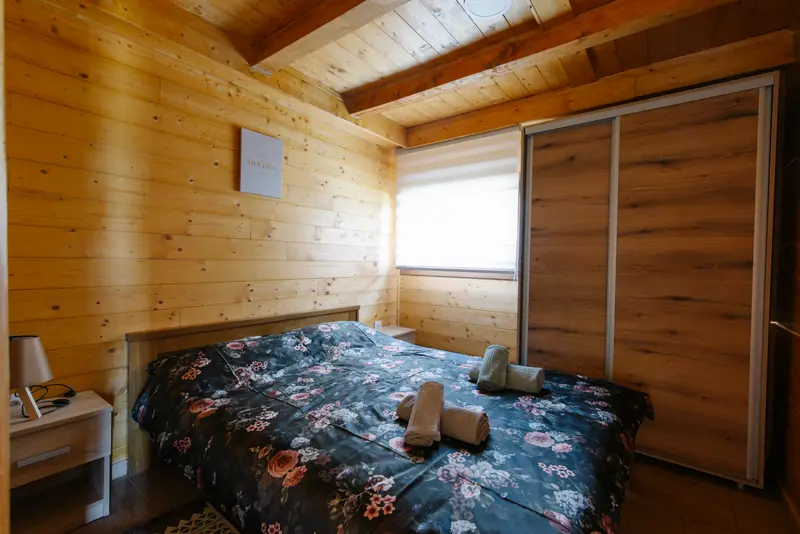
The same capacity of five, in a two-bed unit and a four-bed unit
One line from Chichibu Sadamine Seiryu Camp in Saitama contains the whole problem.
There are two types, a two-bed unit with two semi-doubles and a four-bed unit with four singles, and both sleep five.
One property, one stated capacity, and two beds in one unit against four in the other.
For a party of five those are quite different nights. In one, three people sleep on something that is not a bed; in the other, one person does. The capacity figure carries none of that difference.
Only one property in six publishes what the bedding is
Of the 654 stays listed on Tomaribi, 106 go as far as a bed count: 66 villas and 40 glamping sites, or 16% of the total. Two bedrooms, eight people found 134 publishing a bedroom count, so what is in the rooms is held back more often than how many rooms there are.
Of those 106, 49 mention bedding other than a bed. Futons account for 35, lofts 23, sofa beds 16, bunk beds and extra beds six each. Counting mentions of tatami and Japanese-style rooms brings it to 57.
Roughly half of the properties willing to publish a breakdown.
Eight write down which guest tips into an extra bed
Eight of the 654 state the threshold outright.
THE BOXY AWAJI in Hyogo (sleeps 8): “Parties of seven or eight use an extra bed.” CELESTE SANTO, also in Hyogo (10): “The ninth guest onward sleeps on an extra bed.” UMIBE Ise-Shima in Mie (14) lists five bedrooms with eight singles and two doubles, then adds that “an extra bed takes it to a maximum of fourteen”. Ten people get a bed; from the eleventh it is something else.
R.KAMAKURA in Kanagawa (6): “Using the sofa bed in the living room brings it to six.” CORAL RESORT aoshima in Miyazaki (6) has two doubles, and “adding the sofa bed takes it to six”. FARM VILLA taku in Hokkaido (8): “Using the single sofa bed as an extra bed takes it to a maximum of eight.” MIYAZAKI BASE in aoshima in Miyazaki (10): “Rental futons take it to a maximum of ten.” And HUMMER VILLAGE Amakusa, with its four folding mattresses.
All eight can be read and understood, which is also how you know what the other 650 are doing. The line is drawn somewhere. It just is not written down.
FARM VILLA taku adds one more sentence: “From the fifth guest, an extra bed is charged at 5,000 yen including tax per bed per night.” Four semi-doubles, capacity eight. Four people pay the listed rate and the fifth adds 5,000 yen a night. The add-on charges from per house or per person turn up here in the shape of bedding.
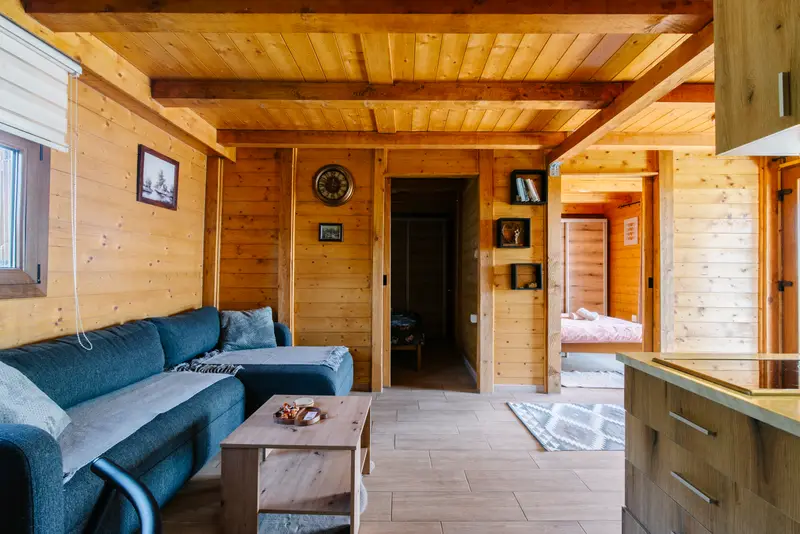
Four beds can mean a capacity of four, or of eight
Espacio Onna in Okinawa has two singles and two semi-doubles across two bedrooms. Four beds in total, capacity eight. No other bedding is mentioned, which works out at two people per bed.
Villa NIGIN Amanohashidate in Kyoto has two doubles and two semi-doubles for a capacity of four. One person per bed.
Same four beds, opposite meanings.
On the one-per-bed side there is also Chikura Dog Villa in Chiba, four semi-doubles for four guests; Villa montpetre in Kagoshima, six semi-doubles for two to six; and POOL HOUSE Awaji in Hyogo, two semi-doubles in each of three rooms for six. Read only the capacity field on a booking page and none of this is visible.
Two adults on a semi-double is 60cm each
A semi-double in Japan runs around 120cm wide. Singles are about 97 to 100cm, doubles around 140cm, queens 160cm, kings 180cm and up.
Split 120cm between two people and each gets about 60cm, roughly six-tenths of a single bed. Lie on your back with your arms at your sides and that is most of it. It works for a couple, or a family with small children. For friends, or adult siblings, it usually does not.
The awkward part is how often the word appears. Counting mentions across the listings: double 53, single 38, semi-double 34, twin 34, king 27, queen 17. Semi-double is the third most common size on the site.
Almost nobody publishes an actual width. Villa VALIOSA ON THE BEACH in Okinawa, with “one Sealy king bed 2,000mm wide”, is the exception; most stop at “two semi-doubles”. How wide those two are is something you find out on arrival.
Futons are not what you lay out when the beds run short
Among the auxiliary bedding, futons sit differently.
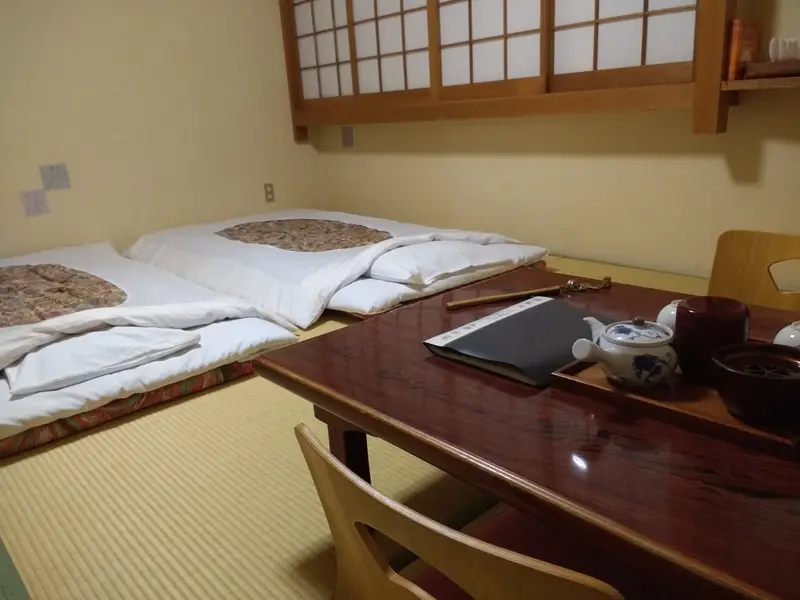
Kinosaki Onsen Yukura in Hyogo (sleeps 6) has two semi-doubles and four futon sets in a single bedroom. It is a converted sake merchant’s storehouse, and futons suit the building better than a row of beds would.
Private Pool Villa Kouri The Sweet in Okinawa (8) has one Japanese-style room with four futon sets and two Western rooms with four semi-doubles between them. An even split, not because the beds ran out but because there is a tatami room.
AMAO VILLA Izu-Kogen in Shizuoka (12) lists one queen, one double, three singles and five futon sets. Its sibling AMAO VILLA Jogasaki (11) runs one queen, two semi-doubles, three singles and four futon sets. Both are about half beds and half futons, and were built that way.
Doggy’s Villa Kamaguchi in Hyogo has two semi-doubles, two single futon sets in the loft and one single extra bed: three kinds of bedding under one roof. L’art de vie Matsuyama in Ehime sleeps up to nine on two bunk beds and a loft. Lining up beds was never the design.
What causes trouble is the allocation, not the bedding
Nothing here ranks one kind of bedding above another, because there is no need to. The trouble is not the type. It is that who gets which one is decided after you arrive.
A sofa bed is fine for one night and can reach your back by the second morning. A loft means going down a ladder or a steep stair at two in the morning. A futon means getting up off the floor. None of that matters much. Depending on who it lands on, it matters a great deal.
Know it in advance and the split on a three-generation trip decides itself: grandparents in the beds, children on the futons. Arrive without knowing and you get a few seconds of silence in the bedroom where the bags are, until somebody says “I’ll take the sofa, then”. That arrangement usually holds until the last morning.
As how many a child counts as showed, the capacity figure answers how many people fit. It was never answering who sleeps where.
About these numbers
The denominator is 654 stays (published, duplicates excluded). 106 publish a bed count, so 552 do not. That says nothing about beds running short; publishing a bedding breakdown is simply not the convention.
The tally was taken mechanically from listings that write a number of beds or futon sets, and is not an inventory. At properties with several buildings or room types, only one type may be described. The bed widths quoted are the usual Japanese conventions, not measurements from any given property. And the eight that state an extra-bed threshold are the number that write it down, not the number that operate that way. Many more presumably do without saying so.
One line is enough
“Could you give me the bedding breakdown?”
How many beds and what size. How many sofa beds, extra beds or futon sets are included. Whether anyone sleeps in the loft. Once the reply comes back you can settle it and share it before you set off, exactly as with the room allocation.
Capacity is the maximum a property can take. How many of them get a bed is a separate number, written somewhere else. Or not written at all.
FAQ
- Are there as many beds as the stated capacity?
- Not necessarily. Of the 106 stays on Tomaribi that publish a bed count, 46% also mention sofa beds, extra beds, futons or lofts. HUMMER VILLAGE Amakusa in Kumamoto sleeps six, but the beds are one double or two singles; the rest is four folding mattresses kept on site.
- Which properties say the capacity depends on extra bedding?
- Eight state it plainly. THE BOXY AWAJI in Hyogo writes that parties of seven or eight use an extra bed; CELESTE SANTO in Hyogo that the ninth guest onward sleeps on one; UMIBE Ise-Shima in Mie lists ten beds and adds that an extra bed takes it to a maximum of fourteen.
- Does the bed count scale with capacity?
- No. Chichibu Sadamine Seiryu Camp in Saitama has a unit with two semi-double beds and a unit with four singles, and both sleep five. Chikura Dog Villa in Chiba has four semi-doubles for a capacity of four, one person per bed; Espacio Onna in Okinawa has four beds for a capacity of eight, which works out at two per bed.
- Can two adults sleep on a semi-double?
- It is tight. A semi-double is generally around 120cm wide, narrower than two singles side by side, so each person gets about 60cm. Fine with someone you are close to, hard to recommend otherwise. Few properties publish actual widths; Villa VALIOSA ON THE BEACH in Okinawa noting a 2,000mm king is a rare exception.
- What should I ask before booking?
- Ask for the bedding breakdown. How many beds and what size, how many sofa beds, extra beds or futon sets are included, and whether anyone sleeps in a loft. With that you can settle who sleeps where before you leave. Extra bedding is not always free: FARM VILLA taku charges 5,000 yen per extra bed per night from the fifth guest.
Stays in this article

AmakusaKumamoto
HUMMER VILLAGE(ハマービレッジ)天草
Rental houses on the shore at Kami-Amakusa where every room faces the ocean. There are whole-house VILLAs and a CRUISER with a cruiser cabin, and Villa C accepts pets.

AwajiHyogo
THE BOXY AWAJI
A container-built villa at Kamaguchi Tsuda on Awaji, split into main, bedroom and bathroom blocks, with a pool, jet bath, barrel sauna and covered BBQ terrace outside.
3 bd

Ise-ShimaMie
UMIBE(伊勢志摩)
Two villas on roughly 1,000 tsubo of ground overlooking the Ise-Shima sea. IseShima runs 270 sqm indoors with five bedrooms, Terrace has an open-air bath, and taking both together accommodates up to 22.
5 bd

KujukuriChiba
千倉Dog Villa
A dog villa at Chikura in Minamiboso taking two groups a day, each room with its own pool, a dog run of over 130 square metres and a self-loyly sauna. 100 minutes from central Tokyo.
1 bd1 ba

Kinosaki OnsenHyogo
城崎温泉一棟貸しの宿 ゆっ蔵(ゆっくら)
A whole-house rental at Kinosaki Onsen, converted from a sake merchant's storehouse dating to the Meiji era. There is no bath in the house; the seven public baths around town are the point. Five minutes on foot from Kinosaki-Onsen Station.
1 bd1 ba